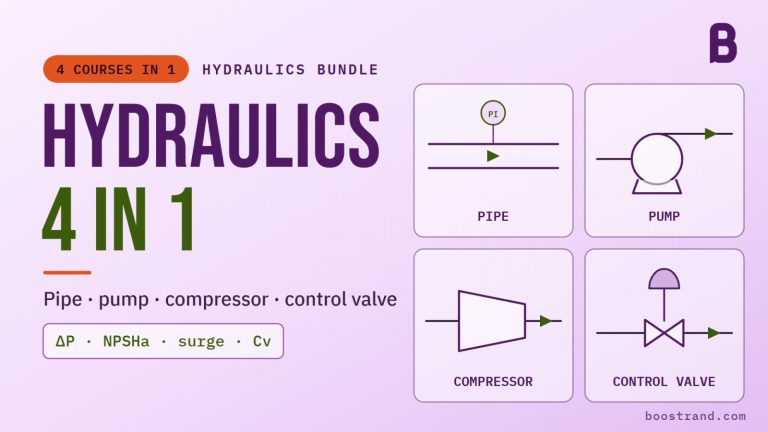
Pipe Sizing Course
Understand how to choose the suitable line size for a fluid service based on the required criteria
27 lessons · 1 h 16 min of video · 2 downloads · 2 quizzes
Certificate of completion
What you will learn
- Understand how to get the proper line size based on flow rate and fluid physical properties
- Effect of fluid velocity on pipe size and common velocity criteria for sizing
- Pressure drop criteria to choose the proper line size
- Discover how pipe size affects the hydraulics of a pump, reboiler and condenser
- Two phase flow and the types of flow regimes
- Let's have practice and see different examples
- Line Sizing Calculation sheet for both single phase and two phase flows
- Quizzes with practical examples to wrap up the course content
- Lessons
- 27
- Video time
- 1 h 16 min
- Downloads
- 2
- Text lessons
- 1
Course content
8 sections · 27 lessons · 1 h 16 min
Introduction
- Introduction1:48
- Main Sizing Criteria1:03
Velocity Criteria
- Effect of Velocity on a pipe and its calculation2:00
- Pipe Sizing Velocity Criteria for Liquids2:28
- Velocity criteria for gases and two phase flow2:00
Sizing the pipe with respect to pressure drop
- Pressure Drop sizing approaches2:30
- Calculate friction factor2:51
- Calculating pressure drop for two phase flow1:15
- Pressure drop criteria3:11
- Hydraulic Loops6:08
Two Phase Flow regimes
- Two phase flow regimes2:53
- How to avoid or reduce slug flow?4:14
Pipe Characteristics
- Determine pipe internal diameter against pipe schedule1:27
- Consider fittings and calculate pipe equivalent length1:52
Section 6
- Lesson 15
Let's start pipe sizing
- Tools to calculate pipe sizing1:53
- Pipe sizing examples introduction3:58
- Pipe Sizing Sheet
- Example 1- Condensate at pump discharge2:30
- Example 2- LPG at pump suction3:56
- Example 3- Gas at compressor suction2:03
- Example 4- Two phase flow example3:20
- Example 5 – Condenser Hydraulics9:40
- Example 6- Reboiler Hydraulics13:20
- Quiz 2
- Lesson 26
So what's next?
- Let's go to the next Level?
About this course
Line sizing is one of the major activities performed by a chemical process engineer during any project. He is always responsible for choosing the optimum pipe size as this is a key factor to ensure a smooth process.
An undersized pipe can cause disturbance to the whole process and may lead to pipe erosion and high pressure drop which may lead to a shutdown. However, oversized piping means more cost, more difficult deliverability, more piping supports, and more foundation, and even sometimes can cause process disturbance in the case of two-phase flow.
Table of contents
- Velocity Criteria
- Pressure drop Criteria
- Two-phase flow regime criteria
- Hydraulic loops and how pipe size affects the whole system
- See examples for pump NPSH, reboiler and condenser hydraulics
- Pipe standard sizes and schedule
- Examples showing how pipe size is calculated
Learning goals
- Choose the correct pipe size
- Understand basic hydraulic principles
- See real-life examples of line sizing calculation procedure with ready-made Excel sheets
- Practice pipe sizing yourself and wrap up the course content with quizzes.
Who this course is for
If you are a chemical engineer or you are planning to join the process engineering career, you should be able to understand how pipe sizing works.
Although this course assumes that you know basics of fluid mechanics, it is a practical course. That’s why it focuses on the practical aspects and how to use the required equations in sizing rather than how these equations were derived.
Your instructor
Mohamad
Process Engineer
Mohamad is a chemical engineer with over 16 years of experience in the oil, gas, and petrochemical industries, particularly in the field of process design engineering. He has worked on projects for various engineering companies. Seeing firsthand the need for practical engineering learning tools, Mohamad began creating online courses and educational content focused on real-world process engineering workflows. He aims to make complex technical concepts approachable through the use of demonstrations, simulations, and practice exercises. Mohamad is passionate about equipping the next generation of engineers with the skills and knowledge to excel in their careers.
Frequently asked questions
Why should I take this course?
If you are a chemical engineer or you are planning to join the process engineering career, you should be able to understand how pipe sizing works. This course shall fill the gaps and supply you with the concepts you need to carry out line sizing or check the pipe size as a process engineer.
Is the course just explaining some theoritical concepts?
Absolutely NOT! This course shall guide you through practical examples and wraps up important concepts in quizzes.
Shall the course talk about equation derivations?
Although this course assumes that you know basics of fluid mechanics, it is a practical course. That’s why it focuses on the practical aspects and how to use the required equations in sizing rather than how these equations were derived.
Can I use the supplied Excel sheet for my private calculations?
Yes, you can. However, please note that the Excel sheets were made just for education purposes. If you shall use it to validate a process or purchase material, then you should validate it yourself, and using it shall be under your sole responsibility.
Don't have PayPal account or have an issue with payment?
Guarantee
30-Day Money-Back Guarantee. Secure checkout, full lifetime access.